

Why we can't get there from Here
Curing Disease, Sowing Dis-ease, and the YouTuber who stares at walls

I. Plain Walls
During last Monday’s lay-on-the-giant-beanbag-and-look-at-my-phone office break, I watched a YouTube video in which a tech worker tried to improve his focus by staring at a wall during his work-from-home breaks. In lieu of heeding his advice and staring at the wall myself, I watched the full 30-minute video.1
While I enjoyed it and the associated jokes,2 it was a line from a blog post about the video (‘twas a productive Monday for me) that struck me:
In 2008 the average person was receiving 34 GB of information daily … Extrapolating [the growth rate], we would be at about 87 GB worth of data today … It is obvious that we are all being drowned in a sea of information.
I’ve written before about how the unrelenting increase in stimuli forms an “invisible scarcity loop.” If you consume 10% more calories every year, you’ll eventually gain hundreds of pounds that would be hard to ignore. However, like the proverbial frog in a pot of boiling water, you might not notice if you consume 10% more noise every year, especially when everyone else is in the pot with you.
While the personal implications of this much “uploaded data” don’t need further belaboring (distraction, impatience, dissatisfaction, etc.), the wider effects warrant some thought.
II. Atoms, Bits, Genes
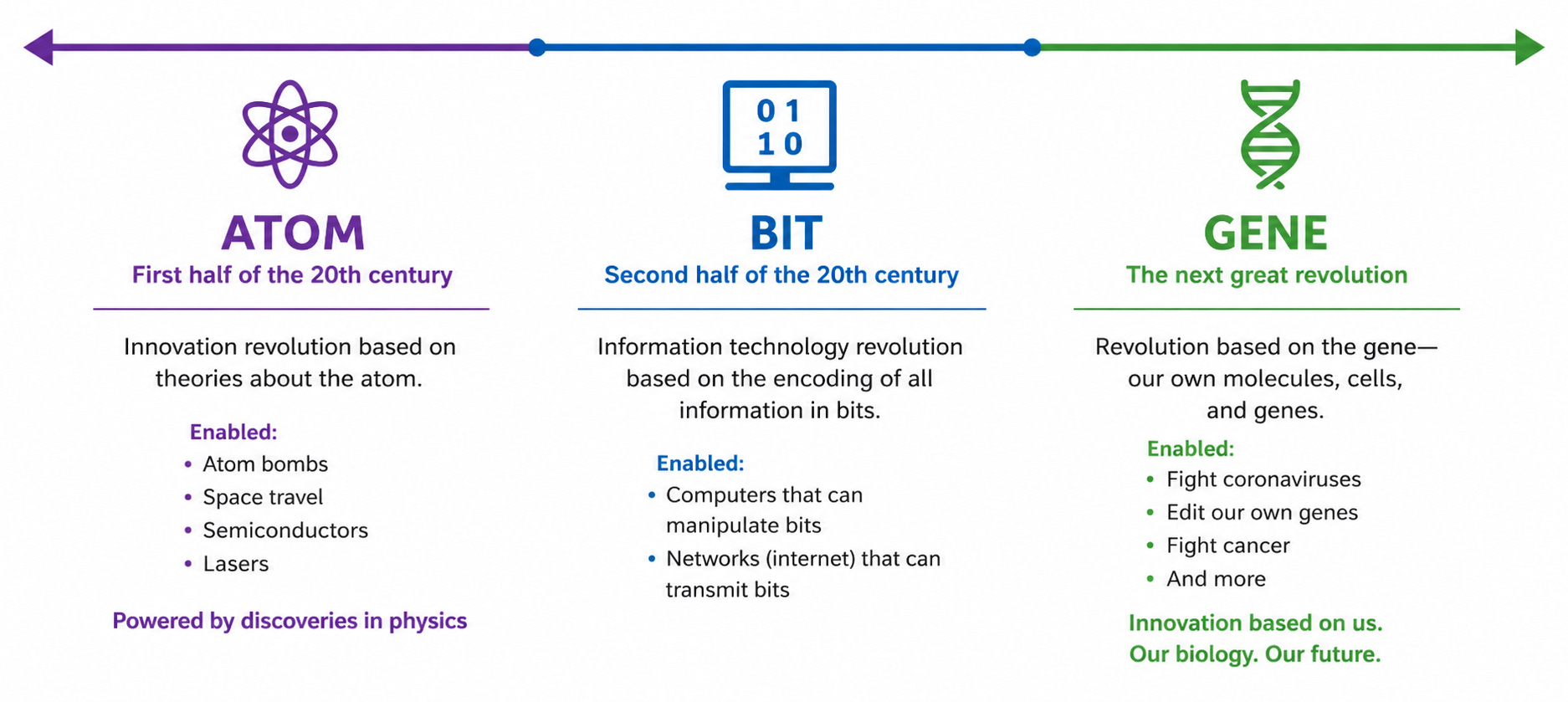
In his 2021 podcast tour promoting the excellent book The Code Breaker, a biography of CRISPR pioneer Jennifer Doudna, Walter Isaacson discussed the three “fundamental kernels” of our existence that people discovered around the year 1900: the atom, the bit, and the gene.
“When I wrote about Einstein, it was about innovation in the first half of the 20th century, based on the theories about the atom … The second half of the 20th century was the information technology revolution based on the encoding of all information in bits, the creation of computers that could manipulate those bits, and the creation of an internet or networks that could transmit those bits. The next great revolution is now, and is based on the gene.
This romantic notion of progress is appealing. The original intent of Future of Tuesday was to share my excitement for these possibilities of the “gene era” like cancer and Alzheimer’s breakthroughs, energy transformations, and structural economic change.3
What I’ve come to believe that Isaacson’s timeline is missing—and why I’ve repeatedly returned to this subject of “why would this guy need to stare at a wall in the first place?”—is that there is no “gene-era” flourishing if we don’t address what’s broken with the techno-status quo.
III. Progress Blind Spots and GDP
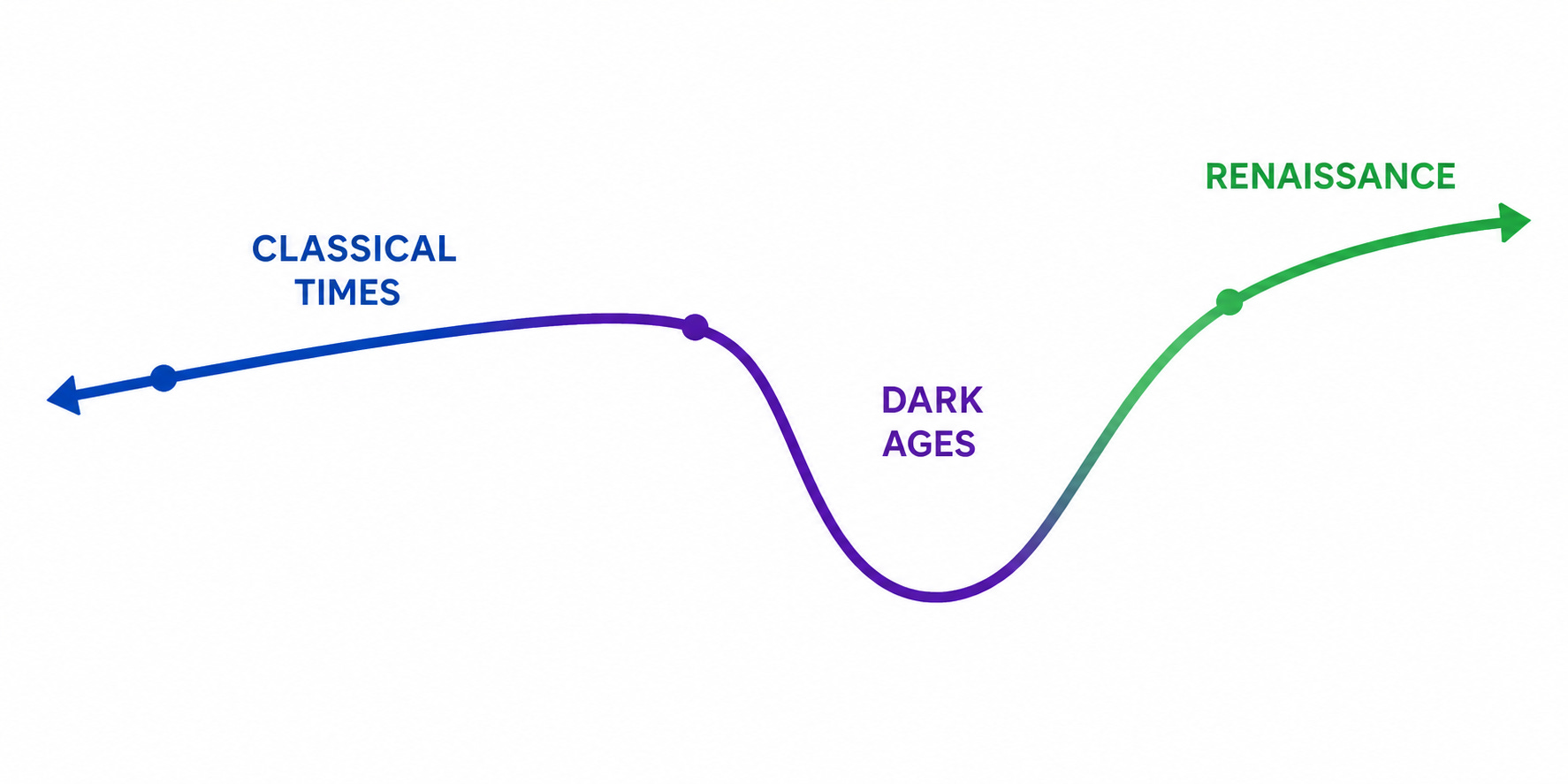
Human progress can feel linear—a slow and steady upward arrow—because everything before today led to today.

While that is technically true, a more accurate depiction of “everything before today” would show plateaus and retreats. Countless Greek and Roman innovations were lost in the West’s 1,000-year Dark Age before the Renaissance.
Because technology and quality of life have both improved exponentially since the Renaissance, it’s easy to equate all tech progress with rising quality of life. Look no further than lead paint, machine guns, and the ozone-killing chlorofluorocarbons (CFCs) to see that some new technology is a step backwards, however.4
While Isaacson is right about the progression of tech innovation since 1900, the breakthrough that most improved human wellbeing since 1900 was likely the victories against infectious diseases.5
IV. Backsliding
One oft-discussed problem with using GDP as a proxy for “Whew ok, things are in fact getting better, y’all!” is that that outlook treats all growth as the same. One million dollars is one million dollars, whether that money comes from Ozempic, lead paint, a new walking bridge, a bakery, or Blue Cross selling something called “health insurance” to Lowe’s for employee “coverage.”
I mention that tech progress and GDP growth can be misleading because they hide the fact that the status quo—i.e. our most recent phase of Walter Isaacson’s “computing bit” era—is broken.
Shortly after the iPhone’s 2007 release, the economy began a bull run that’s lasted nearly two decades.
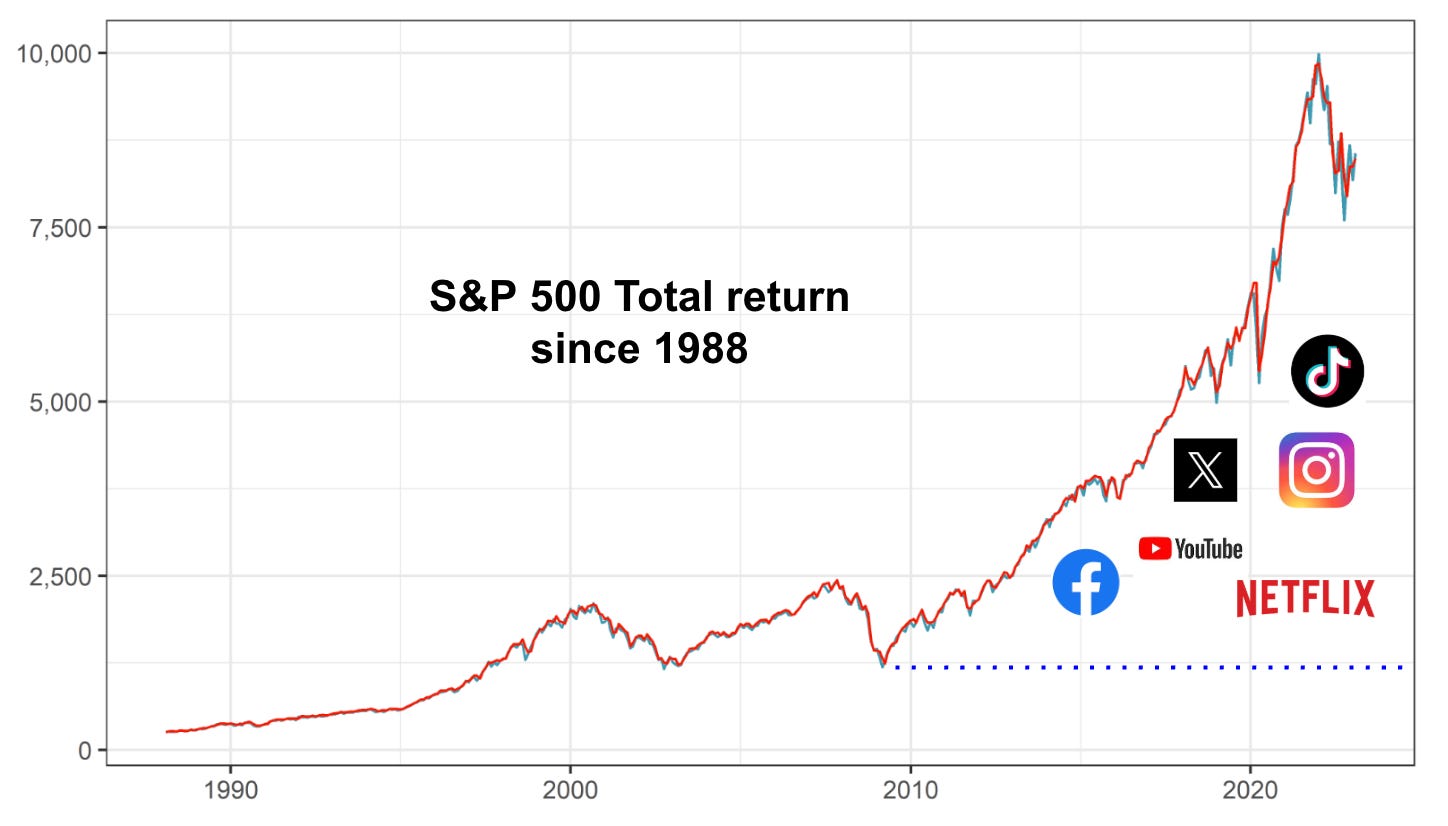
Much of that newfound wealth came from mobile computing, and most of mobile computing’s wealth came from selling people’s attention (see my March essay on the roots of the influencer economy).
Thus, to continue the above theme of absolute growth versus human wellbeing, we’ve added trillions of dollars to the economy, but a huge percentage of those trillions are the product of sowing mass distraction and dis-ease.
By COVID, the dis-ease from the attention economy became undeniable, and it manifests in different forms.
Anxiety: It’s not just that teens, youth, and anyone in the throes of a “who am I?” phase can compare their entire experience of life to the curated posts from peers. It’s that they’re also shown the 0.001% extreme in any given domain: beauty, athletics, wealth, etc. The data show a troubling and unsurprising trend in teen mental health.
Loneliness: Regardless of one’s age, every time we get hooked on a mindless matrix scroll (e.g., short-form video) we literally spend less time doing pre-2007 activities like going outside, touching grass, and just existing in a world not mediated by a screen.
“You pity the moth confusing a lamp for the moon, yet here you are confusing a screen for the world.” — random YouTube commenter
Nihilism: While algorithmic anxiety and loneliness are not brand new, fear-mongers6 have sowed a new form of dis-ease since 2022: AI will take all of your jobs and future prospects, so there is no use trying. Sorry that the first 20 years of your life were wasted in a system that won’t get you a job. While our social contract must change, the widespread (often youthful) sense of dis-ease and nihilism is not rooted in highly specified, concrete fears about knowledge workers going the way of horse-and-buggy drivers. The roots are the fear-stoking content we’re fed that is designed to create outrage and then resignation and more passive eyeball time.
The bottom line is that I no longer believe we can have a meaningful “gene era” if we don’t address the self-inflicted wounds—and their anxiety, loneliness, and nihilism byproducts—of the “bit era” that arose from harvesting attention at any cost.
V. Conclusion: Optimism with two Caveats
I am a techno-optimist and hope to spend much of my career in “gene era” fields and to write about them along the way. But to fully realize that optimism, we’ll need to change both social norms and legislation: while Australia’s social-media ban for kids under 16 is great in theory and possibly fine in practice, we also need to hold the tech giants directly accountable.
I’m now able to rationalize my frequent returns to the attention-harvesting subject because I view it as one of three pillars, equally critical, that will improve the wellbeing of the next generation relative to our own.
I plan to write about all three in 2026 and beyond.
Attention exploitation and the ills of the status quo (plus some mediocre jokes)
A social safety net that is updated for a post-1930s world, including AI and modern labor (plus some mediocre jokes)
The gene era’s exciting future (plus some jokes, good ones only)
See you next week.
On 1.3x speed out of respect for company time, of course.
Such as “bro just accidentally discovered meditation” and “he’s closing browser tabs to save RAM”
There are some parallels with evolution. It’s easy to picture evolution as the gradual and linear improvement of a species’ fitness for millennia upon millennia. But that’s not actually what happens. Evolution involves random mutations, some of which stick around and spread across future generations because that specific mutation improves survival rates. But not all mutations are helpful for survival, so we wouldn’t see those genes from (say) 4 million years ago passed down to today.
Like genetic mutations, most new tech is irrelevant and quickly forgotten. But because we live in the here and now, it’s hard to remember that something new might be a step backward.
Improvements in food production deserve mention, as do nuclear weapons as a deterrent to another world war. Regarding the incredible quality-of-life impact of curing infections, here is a chart showing the 10x reduction in infant mortality since 1935.
“Fear-moggers” is way funnier and honors my 2026 vocabulary.