

The 193-Year-Old Roots of the Influencer Economy
Power laws, FOMO, and illusions

If I had one dollar for every person over a certain age who I’ve heard say that “kids don’t want real jobs, they just want to be influencers,” I wouldn’t have let this sterling silver bowl get away from me during its auction.
Although the influencer appeal can befuddle the generations that remember a time before smartphones, young people didn’t develop the interest merely to piss off society’s elders. To make sense of those pursuing cents from clout and eyeballs, today we’ll answer some questions.
Who pays influencers if they don’t have “real” jobs? (What even is the economy?!)
Why, financially, do kids want to be influencers?
What are the effects of the growing pursuit of being an influencer?
Should non-influencer young professionals feel FOMO?
I. How did we get here?
To understand the influencer economy, let’s start from the top:
The most critical need for any business is customers.
To gain customers, a business wants to convert potential customers and grow the “potential customer” denominator.1
The internet broke down all barriers to reaching “potential customers,” but since the barriers are down for everyone, there is infinite noise and competition. Most people don’t know your business exists, so they aren’t potential customers until they discover you through word of mouth (e.g. Reddit) or advertising.
Clickbait began during Andrew Jackson’s presidency
In 1833, the leading newspaper in NYC, the New York Enquirer, had fewer than 3,000 subscribers in a city of 300,000 people. Subscriptions were expensive, so readers were almost exclusively from the elite. As Tim Wu illustrates in his excellent book, The Attention Merchants, an entrepreneurial 23-year-old named Benjamin Day realized he could dramatically increase readership by lowering prices and appealing to the masses through gaudy content.
In doing so, Day birthed modern American advertising.
Per Shannon Rupp:
There was a growing awareness that selling eyeballs to advertisers, rather than information to readers, could be a more lucrative business…
Day didn’t consider himself a journalist; he was a businessman who needed to keep his press humming to make a living. So he launched the New York Sun for a penny, and before you could say “National Enquirer,” he graduated from running true-but-sensational stories about suicides and drunken wife-beaters to fiction masquerading as fact.
After newspapers and magazines, radio and TV followed this model of subsidizing the cost of subscriptions by selling eyes and ears to advertisers.2 The early internet functioned largely the same way—banner ads and pop-ups on websites—but that model eventually evolved (more below).
The two changes that birthed our economy
When a few hundred million people went online in the late 90s, countless longstanding media companies (like local newspapers) became insolvent and shuttered. The culprit was that the internet eliminated two constraints that everyone took for granted.
First, as mentioned above, distribution became free. For 100,000 years, ideas solely spread through word of mouth. Then came papyrus and stone tablets and medieval monks laboriously copying text by hand. The 15th-century printing press sparked the biggest pre-internet knowledge revolution.
For the ensuing 550 years, however, the diffusion of ideas via printed copies was still gated by the physical world. While the telegraph enabled faster communication, usage was concentrated, so it was the internet that actually broke all physical barriers. Outside of a few national newspapers, local papers previously had distribution monopolies. Now, people could access information from anywhere in the world.
Second, content was no longer scarce. Anyone in the world could now publish their writing and photos, and, as computation improved, they could upload videos, too. The combination of “access content from anywhere” and “abundant free content” made it impossible for legacy companies to keep most paying customers.
The genesis of influencers
In the early 2000s, as dying media companies paid journalists to write professional content, a handful of startups realized that “free distribution” and “abundant content” meant they could pay their journalists zero and still sell ads. A journalist, in this context of those startups, actually just meant "a random dude uploading the Evolution of Dance,” “a college kid ranting about his faltering love live,” and “a random girl posting photos of her cat and latte foam art.”
In other words, any website could generate attention and sell ads against those eyeballs by having users upload content for free. If you were YouTube, that meant there was no need to pay MGM to make a movie; if you were MySpace, it meant your content contributors did not need master’s degrees to write about themselves.
In practice, users quickly clustered to a few websites that their friends were already using (a phenomenon called “network effects”). Internet companies battled for supremacy in a modern gold rush. Google had already won search. YouTube won video. Facebook killed MySpace in social networking. Netflix later won TV streaming, and (even later) TikTok and Instagram battled for short-form video.
The very few winners in each space became known as “aggregators.”3 Human attention followed a power law, in which the overwhelming majority of attention clustered to these aggregators, followed by an infinitely “long tail” of sites (like mine) that comprise a sliver of online attention.
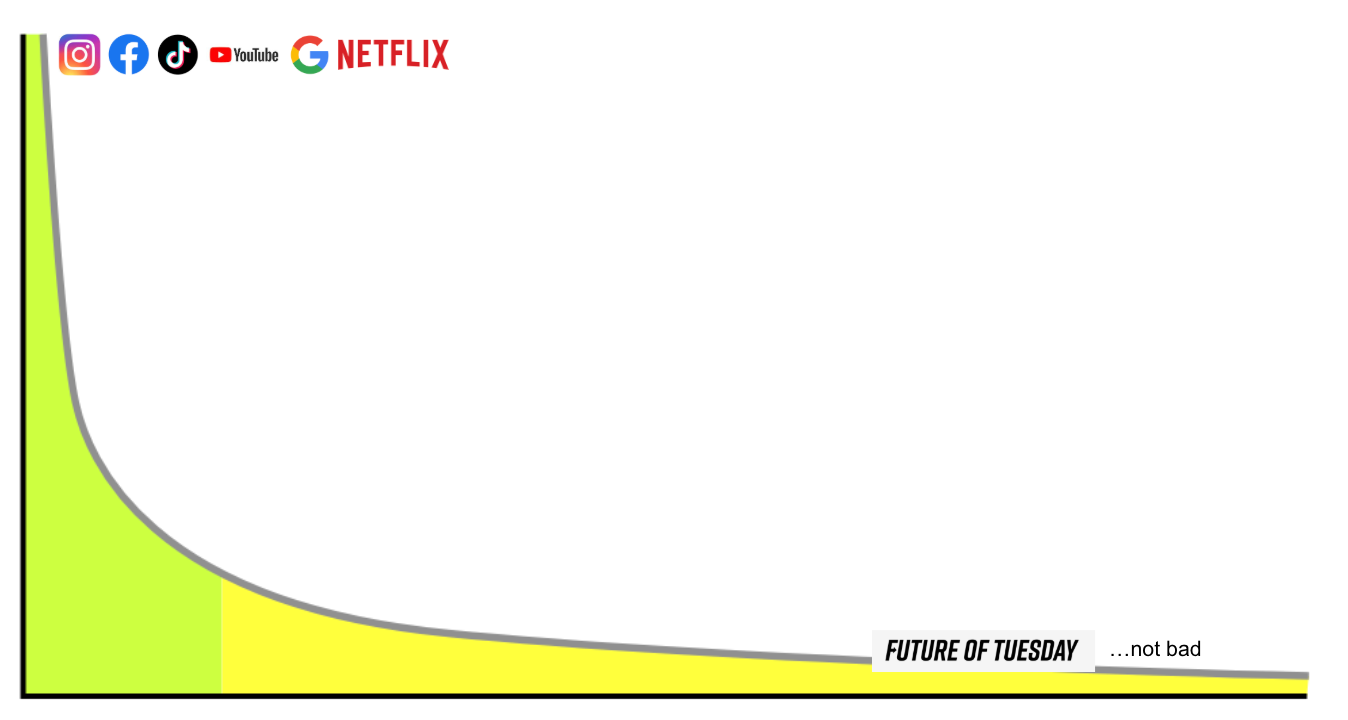
When distribution constraints died, attention power laws took their place. For the aggregators, selling ads in front of an audience of billions of people without paying 99% of their non-Mr.-Beast content creators became the greatest business model of all time.4
Incredibly, an even bigger financial breakthrough came later: the algorithm that personalizes ads for each pair of eyeballs.5 Personalization increased the conversion rate for ads, which meant businesses were willing to spend even more to target tiny and specific fractions of Instagram users.
So how does this lead to influencers?
Thanks to the TikTok model, aggregators realized that the most attention-worthy global content was more compelling than content from a user’s own social graph. In other words, you might spend 20 minutes looking at your friends IG Stories, but 100 minutes on Reels from total strangers. Thus, free content creators quickly followed a similar power law to that of the aggregators.6
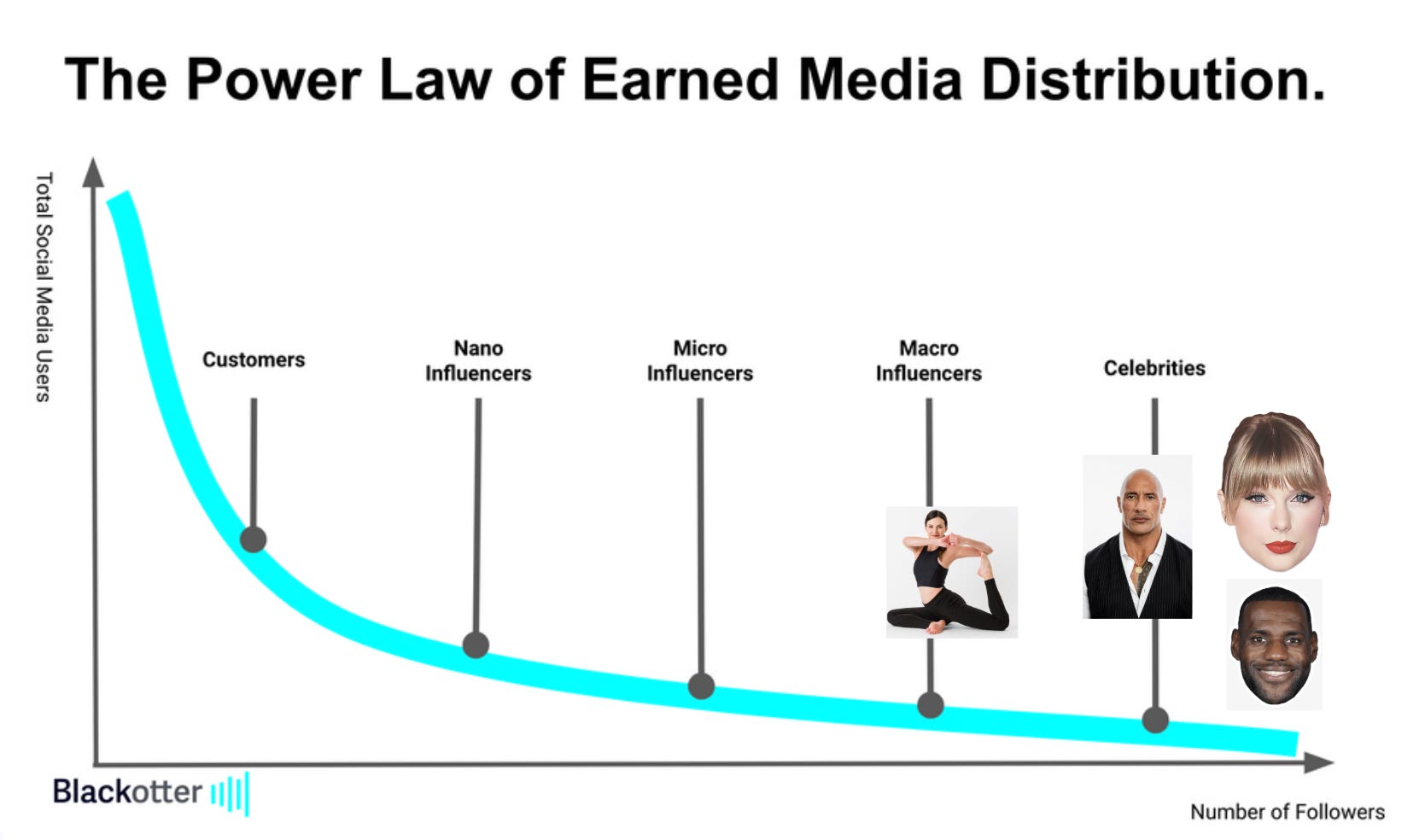
In the new TikTok-y model, a small subset of content creators now received the vast majority of attention, making them highly valuable to advertisers. Businesses started paying the creators at the top of the attention power law (i.e. “influencers”) to peddle products and services, offer affiliate links, do live reads, or simply use their products on camera.
That was a lot, so here’s a a four-sentence recap:
Free distribution means anyone can publish content.
Users (who are both consumers and creators) tend to cluster in a few “aggregators” (Google, FB, Insta, etc.) which grow stronger and more impenetrable with each additional user.
Users provide content for free, and since the final scarce resource is attention, attention follows a power law.
The creators at the top of that power law can monetize their attention, so we call them “influencers”
II. Why do kids want to be influencers?
In an age when many young professionals are saddled with decades of student-loan debt and are told that AI is about to take away the jobs they probably don’t enjoy anyway, it’s rational to want to get paid to post content on free platforms.
They see other young people (who appear to be) making money and living (what appear to be) glamorous non-corporate lives. Plus, the millions of anonymous influencers who haven’t hit power-law escape velocity are invisible, so it seems like being an influencer is the most realistic path to outlier success.
III. What are the effects of the growing chase to be influencers?
Instead of making Luddite judgments or lamenting distraction, here are some observations:
The real winners are undeniably the aggregators. YouTube and Instagram don’t need you to succeed at engaging eyeballs. They just need some people to do so. And, if you do something that isn’t in line with their rules, or you’re merely mistaken for doing so by an algorithm that’s designed to keep the platforms from getting sued, you can vanish in a moment.7
One (arguably) positive externality is discoverability. The internet’s millions of niches are integral to its “long tail.” Small and unknown businesses can target my mother, for instance, with influencer-peddled products as she consumes her niche of nostalgia-core Clean Sweep content.
A negative externality is that the algorithm rewards anti-social behavior. The algorithm only rewards attention (with exceptions for illegal content). In the world’s noisiest arena, the most extreme content gets attention.8 “Most extreme” can mean world-class athletes, musicians, artists, supermodels, or any useless skill performed before Howie Mandel. Far more often, “most extreme” means average-ish people doing divisive or inflammatory shit in an attempt to hack the algorithm (see: Alex Jones, or the dudes in the park who use unwitting strangers for clickbait).
IV. Conclusion: reducing FOMO
The path to easy money is an illusion.
While I said it’s “rational” that influencing is more appealing than corporate work, there are distortions at play. Next time you’re confused how someone without million of followers and without a job is taking beach photos for a living, trust your skeptical instinct. They likely are actually not as rich and unstressed as they seem, or they have a trust fund (the one actual easy path).
A former colleague of mine struck it big in an NFT release (back when that was possible) and quit his day job. When I saw him 9 months later, he was grinding 12–14 hours a day to build his ensuing business. I will always advocate entrepreneurship, but my point is that consistent 12-hour days are not “easy money.”
Unless you are worsening the world with your content, there is nothing wrong with wanting to be an influencer.
But it’s important to see the truth: aggregators’ customers are advertisers, advertisers’ customers are eyeballs they want to sell to, and most influencers are merely an unpaid vehicle for these other parties to match with customers.
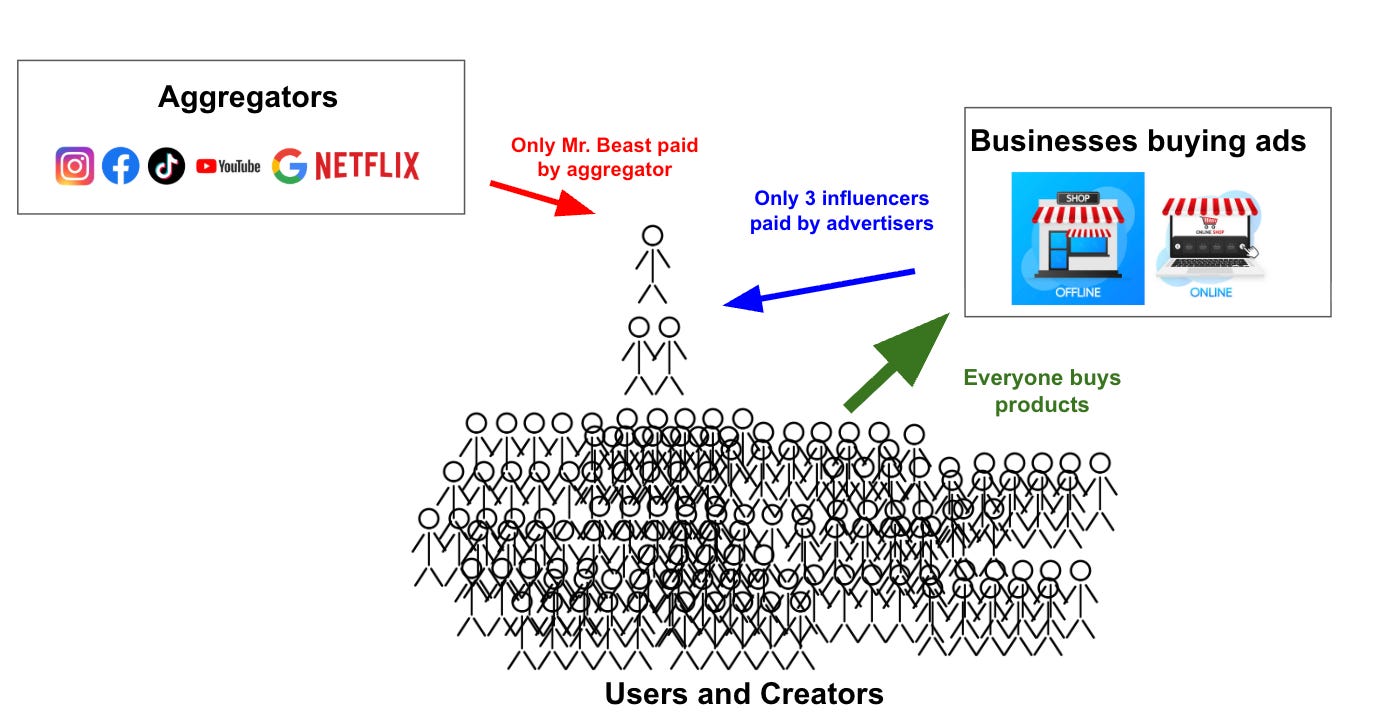
Young people entering the real world needn’t feel FOMO. While unpaid labor could lead to some money and free products, you’ll likely make a lot more money with a paid job or from your own business.9 And with that better money, you can actually afford some nice beach vacations.
That conversion rate (whether 0.1% or 55%) typically matters less than the size of the “sales funnel” itself (i.e. the denominator). One percent of 350 million Americans is a larger baseline than 100% of San Diegans.
While internet clickbait has unmatched personalization and addictiveness, it has precedent: to see its ancestors, look no further than the local news (and the modern daily-news podcasts). Is my local news channel jump-cutting to a recap of the plane crash in Kazakstan because it impacts a single person in my city, or because shock and dismay and horror keep our eyeballs around?
Ben Thompson has written about “aggregation theory” more eloquently than I will here, but the idea is that aggregators are rich at an unprecedented level because they’ve aggregated digital demand, and that demand persists because of network effects, economies of scale, brand awareness, etc.
Google was already generating annual profits of more than $6 billion by 2009! In 2025 that number was more than $120B.
Targeted ads work differently than many people think. It’s less “Big Brother has a digital file of your addresses and purchases and sexual history” and is more “algorithms sort you into inscrutable ‘lookalike audiences,’ which are based on your probability of clicking on certain types of ads.” The black-box algorithms are better, in some respects, than KGB-style files, but scary in the sense that the algorithms aren’t fully under human control.
It’s not as concentrated as the platforms are (i.e. more than 5–10 creators get tons of attention), but the graph would look roughly the same.
You can try to litigate, but they are worth trillions of dollars, so good luck matching their legal fees. (Thus, the median lawyer earns far more than 99+ percent of influencers.) As an aside, this ability to de-platform you is why modern business gurus tout the (now-clichéd) importance of “owning your own email list.”
A similar effect is true in crowded primary elections, as we’ve learned since 2016.
That is true even when AI comes, because AI influencers will come for you next.