

Addiction and Subtraction
The Invisible Scarcity Loop's Fire Hose

The Big Loops
In his book, Scarcity Brain, Michael Easter describes various "scarcity loops" that wreak havoc in our modern lives. These loops include calorie-dense foods, drugs, possessions, information, and a desire for social status.
Since humans evolved in a world of scarcity, people who hoarded these categories tended to survive past reproduction, so we’re all the recipients of those genes. After millions of years of scarcity, however, we find ourselves mere decades into a world of abundance. You can now, for instance, pop an edible and eat 15 Twinkies while scrolling TikTok, making debt-fueled Amazon purchases, and watching Love Island on a second screen. Doing so won't even kill you for a quite long time.
Scarcity loops pit our long-term best interests against the limitless instant gratification of the abundant world.
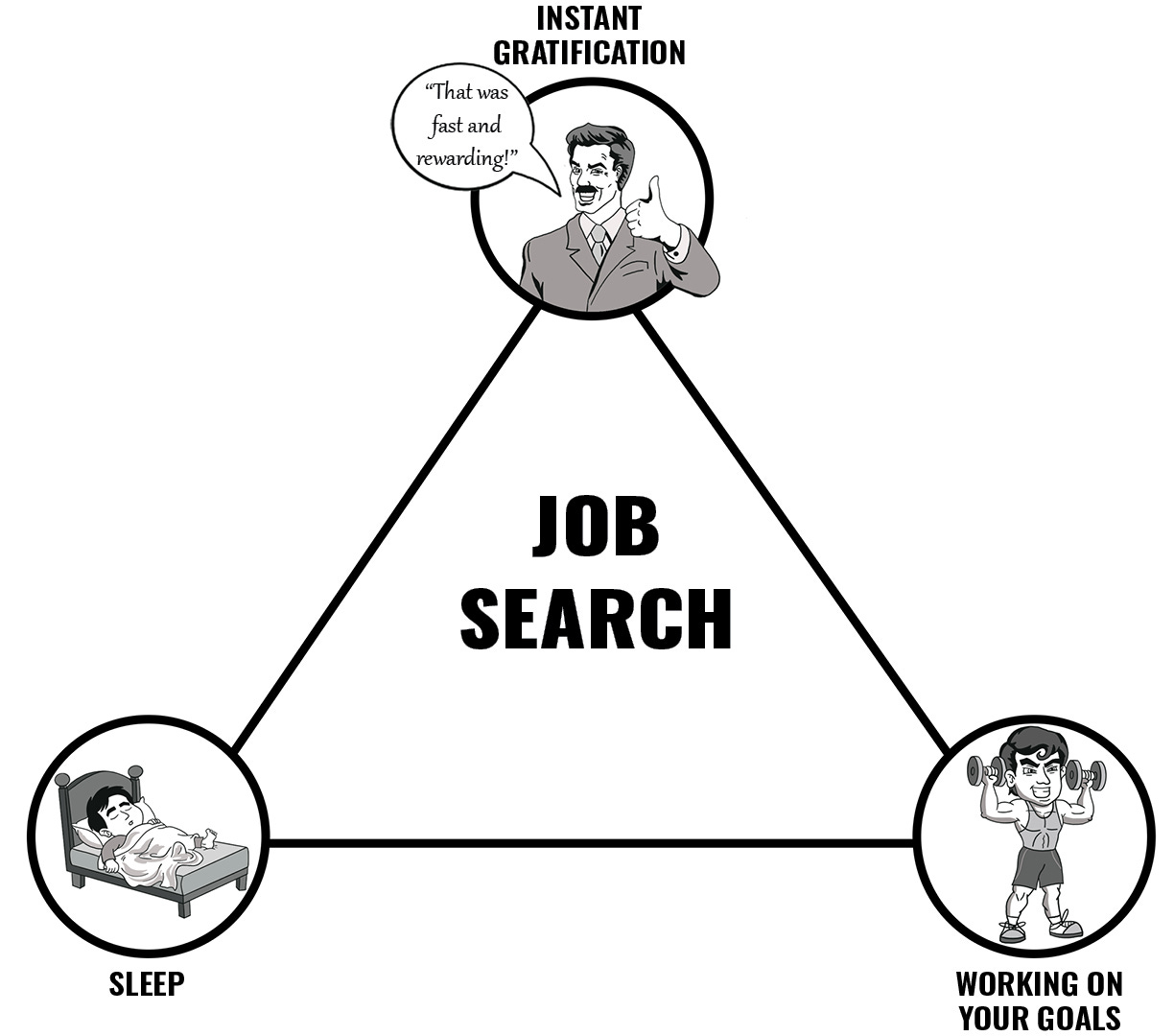
Substitute “job search” for any long-term goal, and you have the modern struggle.
Let’s expand on a specific scarcity loop. If you are a long-time reader (to whom much will be given in the afterlife), you can guess which loop I think about the most.
The Fish-in-Water Loop
Next time you're waiting somewhere alone—in the grocery line or as car number 38 in the Chick-fil-A drive thru—turn off the music or true-crime podcast and wait a whole minute before grabbing your phone. See what you feel. Agitation? Anxiety? If you're like me, you'll feel palpable discomfort, like you're naked in a not-fun-kind-of-naked dream.
From the printing press to dishwashers to microwaves to Prime delivery, technological innovation has always come with the promise of freeing time for leisure and relaxation. In theory, that unprecedented leisure time now exists. In practice, in the 2020s, we largely use that time to guzzle from the fire hose of stimulation.
That stimulation can be enjoyable if your friend sends you a funny meme, you watch a great movie, or you read a good book.
It can also lead to regret and suck your soul like a dementor: TikTok time warps, Instagram subconscious-envy doom scrolling, or Twitter outrage when politically-active Russian bots seem so real because they have a profile picture. (Incidentally, social media bots are not supposed to look like robots.)
Technology's utopian promise of freeing time came true—we can commute more quickly and spend less time on chores than our great-grandparents did—so why does the world feel more hurried and exhausting than it used to?
My hypothesis is that a single scarcity loop—the information loop—permeates every aspect of our lives and warps how we see the world.
The digital world is always accessible to us, which was not the case 20 years ago. It now offers more instant, interesting, and personalized information than we can consume in 10,000 lifetimes.
I do not mean to make light of the term “addiction,” and although it’s part of this post’s title, I don’t think it’s the best way to describe the information loop. Instead, we can borrow an analogy from David Foster Wallace’s 2005 commencement speech, “This is Water.”
In the now-famous address, Wallace encouraged graduates to become more aware of their self-centered instincts. Just as fish live in water—making it invisible to them—we all go through life feeling like our problems are central to the universe. That feeling of centrality and importance is our version of living in water.
Over the past 15 years, the information scarcity loop gradually filled every idle moment of our lives, like water infiltrating the cracks of life’s rock.
The information loop became our “water” because it could do so invisibly, and that invisibility is unique.
Most scarcity loops have clear limiting cues that tell us to stop over-consuming. With food, your body eventually says, “Maybe stop eating 55 Snickers per day, dude, you gained 35 pounds in seven weeks and none of your clothes fit.” When buying and accumulating “stuff,” feedback exists in the form of going broke, like getting your home foreclosed after you took out loans to buy a Cybertruck and Supreme t-shirts.1
The information scarcity loop offers no such obvious feedback mechanism. We might feel unhappy or confused by doom scrolling, but glaring warning signs rarely accompany overconsumption.
As the loop’s water filled the cracks of life, we grew to subliminally expect digital features—like instant access to endless personalized stimulation—in the non-digital world. That is why the real world feels more hurried and exhausting, to answer the question above.
Those expectations have made us impatient and agitated, because the real world does not align with our digital demands of life. (The traffic jam does not care about your meeting and will not be moving soon, because someone who was texting caused a 13-car collision.)
"The decanted infant howls; at once a nurse appears with a bottle of external secretion. Feeling lurks in that interval of time between desire and its consummation." - Aldous Huxley, Brave New World
Chugging the Fire Hose
To restate the opening idea about the “scarcity brain,” humans benefitted for a long, long time from soaking in every morsel of information (and food, etc.) from their surroundings. Information was a slow trickle, so capturing all of it maximized the chances of survival and reproduction. The problem is that we (thankfully) now live in the world of abundance, where the trickle of information has become a fire hose.
We still harbor the instinct to capture all incoming information, but doing so means we take in much more than is helpful. Our thirst extends far beyond the point of marginal utility, i.e. when the negatives start to outweigh the positives.
Reading Tweet number 880 does not add value to my life or make me smarter, but I have a biological urge to add more and more to my imaginary queue.
Our thirst for information also extends beyond the point of marginal pleasure. The uncountable lifetime hours on social media are a blur; none of the best 500 memories from my life has arisen from those hours.
If filling every open sliver of life with inbound information is “normal” in the statistical sense, that normalcy leads to problems (see: smoking before the 1970s).
First, I’ve had enough multi-hour YouTube binges to know that it’s possible to feel simultaneously bored and brain-fried.
Second, after a few days in the Slack-email-Zoom-Twitter hamster wheel of remote work, face-to-face interaction can feel under-stimulating and anxiety inducing.
Third, you know how the world seemingly began imploding in the 2010s? I believe it was actually a collective decline in mental health—and an uptick in anger, distrust, fear, and impatience—brought forth by the information scarcity loop.
Future Tuesdays and the Loop
Taking multi-hour breaks from the information loop feels wildly uncomfortable at first, and suppressed thoughts and feelings might emerge.
It seems clear, however, that goodness lies on the other side of that initial discomfort.
In an attention-deficit world, a real attention span aids professional success. (As now-famous CEO Sam Altman once wrote, “Extreme people get extreme results.”)
Even in one’s personal life, people notice—and physically feel—the contrast between someone who is paying attention to them and someone who is distracted by the information loop. Most people are habituated to checking their phone dozens of times during a one-on-one encounter. (I say that as an observation, not as the old-man-who-yells-at-cloud, because I’m guilty.)
Based on thousands of years of human wisdom, peace and happiness never come from solving one’s endless external problems, but instead arise from changing one’s internal state. Peace of mind is not achievable without self-awareness, and there is no self-awareness when one is constantly overstimulated.
Personally, I’m terrible at taking breaks from the information scarcity loop, but I’ve thought about the topic for a long time. My pseudo-paranoia about the loop has become slightly more commonplace since I began blogging five-plus years ago: Apple introduced the iPhone screen-time feature in 2018, everyone agrees that Instagram sabotages teenage mental health, and most people are now generally aware that “free” websites harvest human attention to make trillions of dollars.
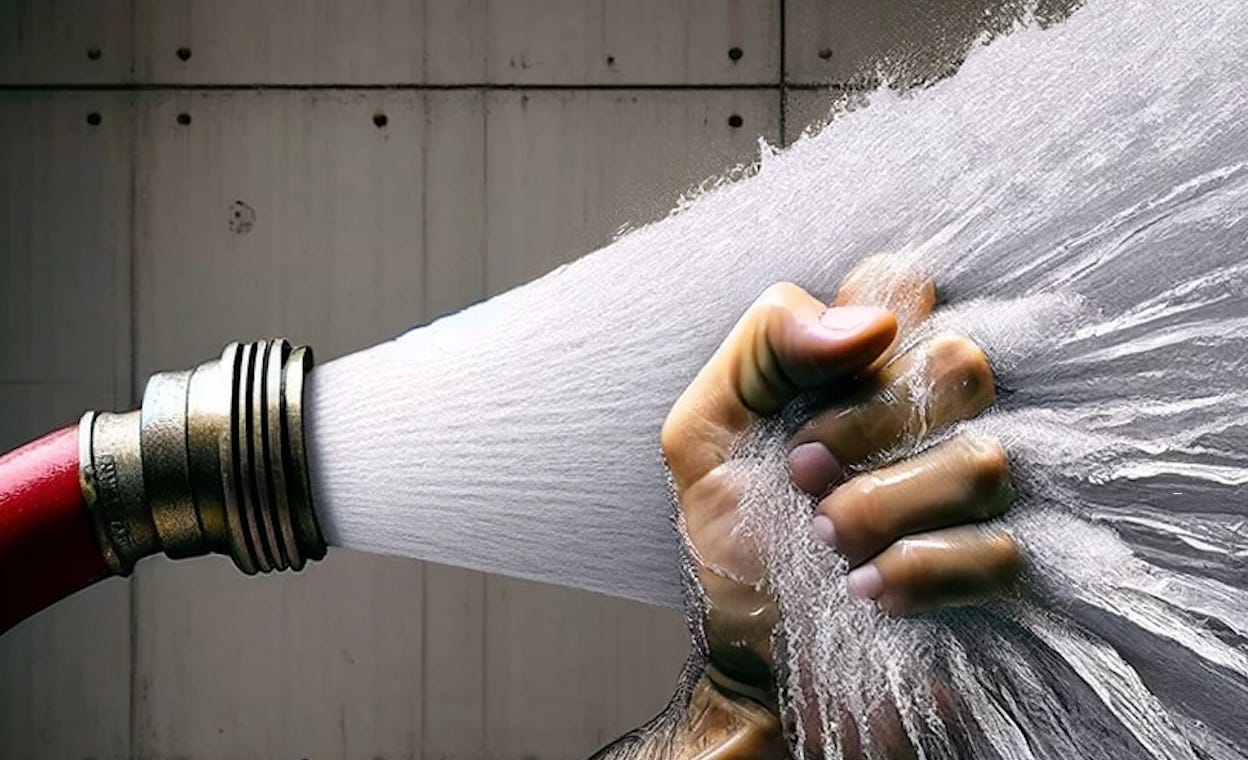
If I’ve learned anything from spilling years of ink on this topic, it’s that no amount of willpower can overcome the tricks and targeted algorithms of the attention economy. Little hacks can help here and there (e.g. deleting certain apps so you can only access them on a computer), but they are the equivalent of covering the fire hose with your hand.
If the idea of taking breaks from the information scarcity loop resonates with you, the only real answer is conscious subtraction.
Delete one of your social media accounts. Take a walk without your phone. Turn it off when you meet up with someone, and keep it off when they get up to pee, even if you feel like people around you have decided you’re a serial killer. Experience the terrifying silence of the Chick-Fil-a drive thru.
A mere 60 years ago, seeing your neighbor go for a jog would have been a serious cause for concern. Today, taking frequent pauses from the information scarcity loop isn’t even that extreme, but it will still put you in the minority. On future Tuesdays of the coming years, I expect more people to turn to subtraction to gain peace of mind in a world that lacks it, and doing so might even become “normal” (hopefully around the same time that jogging goes out of fashion).
Thank you for reading, and please subscribe for posts on most Tuesdays!
Granted, money itself can feel more scarce than your “stuff” does, which softens the urge to buy things unceasingly.
Awesome stuff, Paxton! Putting words to a sensation that many of us feel hard to explain. Really great read dude!