

Killing Burnout: Why Knowledge Work will Improve in the 2030s
The Good Barbell vs. the Unpleasant Bell Curve

[Author’s note: welcome to Future of Tuesday, a weekly post about various technologies, as well as psychology, careers, and other potpourri. If you hate reading, hit the play button above for the audio version.]
I. The barista and the patent lawyer
"Sounds like someone has a case of the Mondays." - Nina, Office Space
While all jobs require knowledge, we’ll use the term “knowledge worker” to describe a specific type of job. It’s a hard category to perfectly define, but one proxy is, “Could I do this job remotely if were sick?”
Excluded from this definition are doctors, nurses, teachers, mechanics, servers, baristas, retail-store workers, home-health aides, occupational and physical therapists, construction workers, athletes, etc.1
Included in this definition are consultants, digital marketers, software engineers, many types of salespeople, lawyers, data engineers, many executive and virtual assistants, managers in health insurance conglomerates, etc.
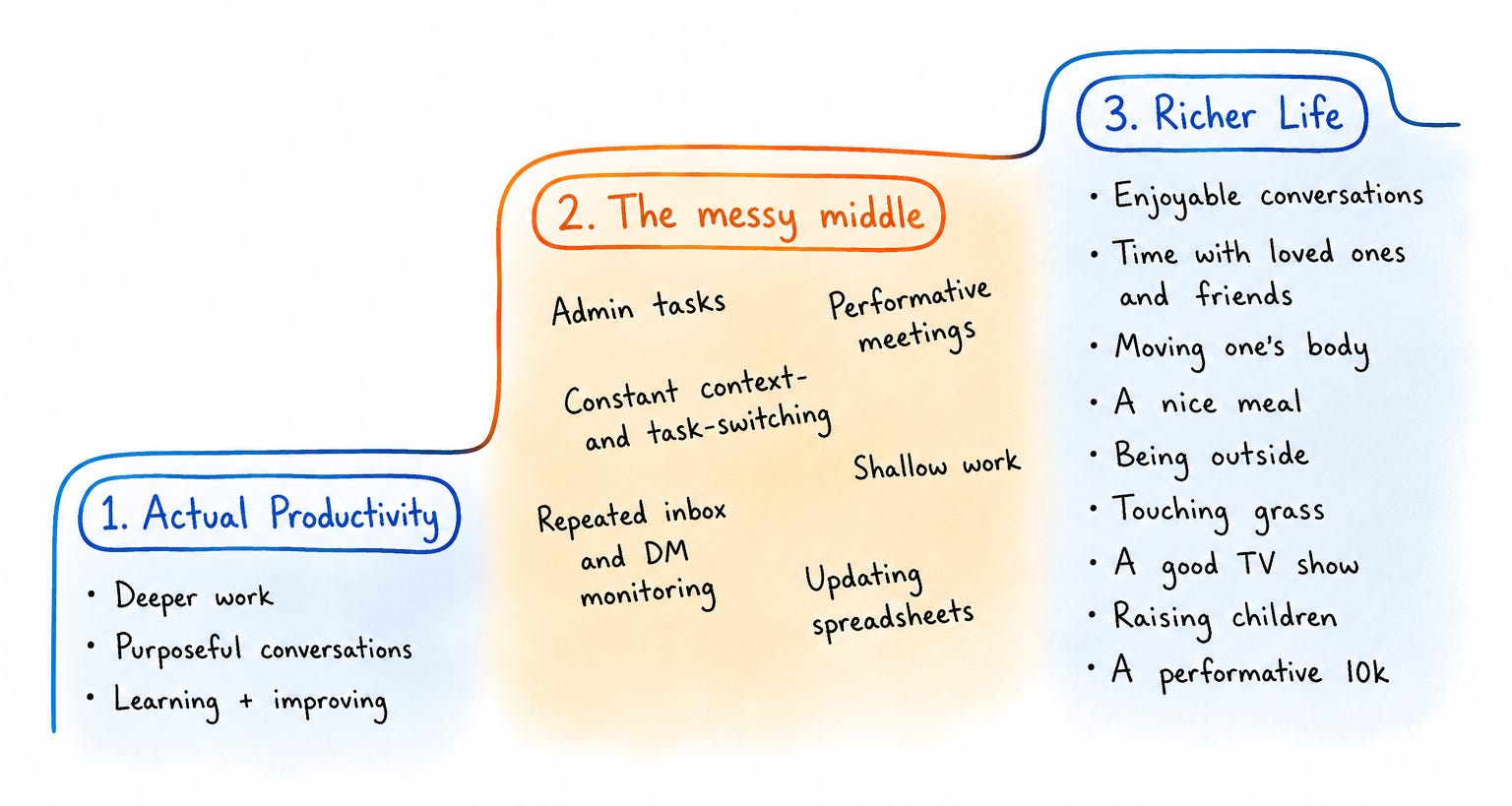
Knowledge-work jobs exist in corporations both large and small, and many knowledge-work jobs do benefit from operating face-to-face (e.g. a trial lawyer or someone selling to a CEO). Thus, my goal isn’t to quibble about which jobs fall into which category, but to instead observe that the median knowledge-worker’s weekday in the year 2026 looks something like this:
II. The Blackberry and the cubicle
"I would say I do about 15 minutes of real, actual work, each week." - Peter Gibbons, Office Space
While cog-in-the-machine corporate jobs far predate computers (see: Ebenezer Scrooge’s underpaid clerk, Bob Cratchit),2 the rise of modern knowledge work coincided with the proliferation of PCs and the early internet. Look no further than Fight Club and Office Space (both from 1999) to understand the prevailing sense of malaise in the cubicle age.
In the 2000s, we added cell phones to the mix, and the “Crackberry” era changed expectations for corporate communication (see: Ryan Howard rudely ignoring Michael Scott). Then the iPhone won the game in the U.S., and email and messaging apps (DM platforms like Slack and Microsoft Teams) followed employees home from work.
The problem with the messy middle—shallow work and task-switching in the above chart—is that it’s fatiguing, unfulfilling, and it decreases actual productivity.
It also can create a Burnout Doom Loop.
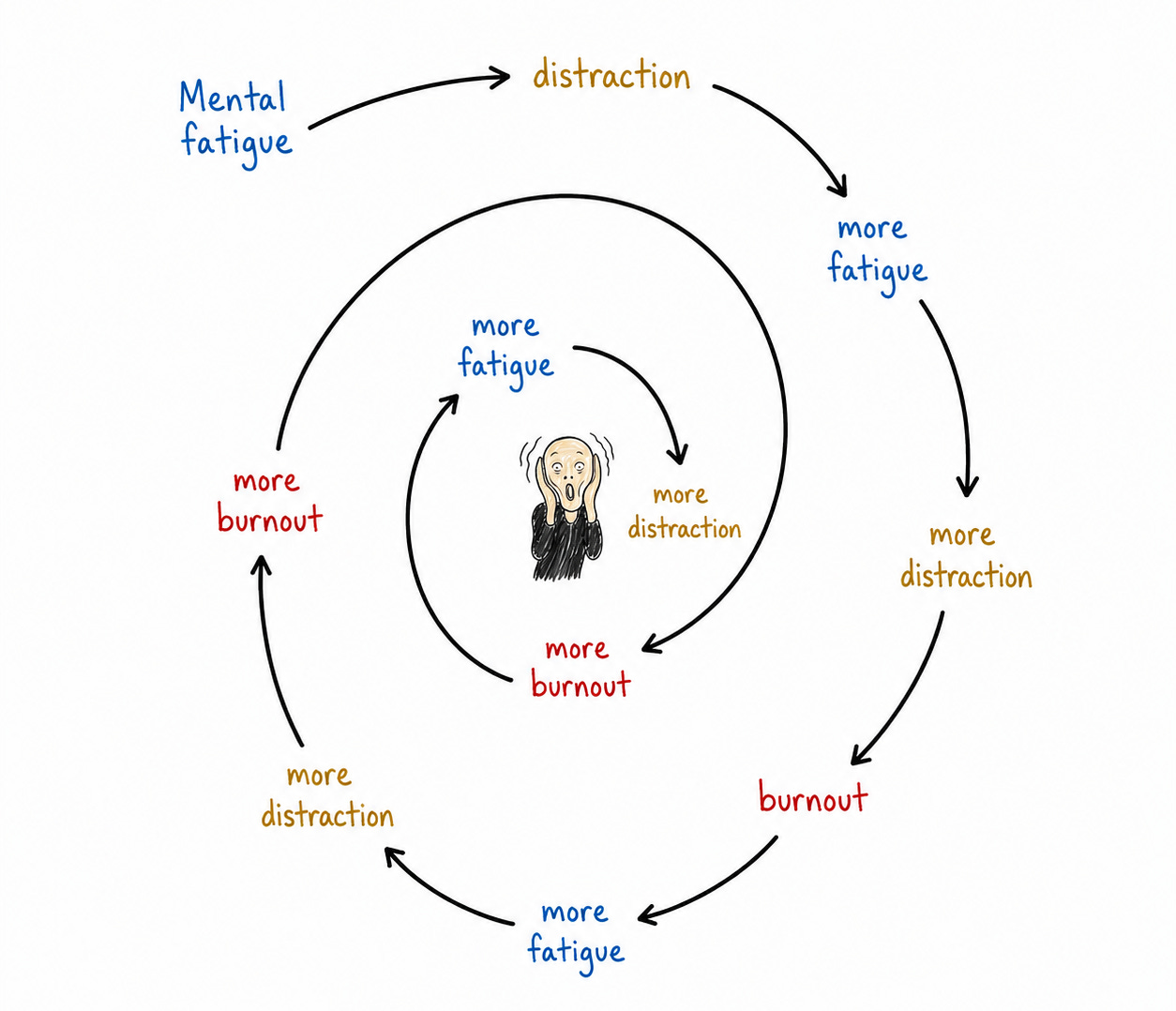
Since burnout, like work, can follow people home, hordes of people feel its effects in other parts of life. Small-screen numbing fuels the cycle even more, and a life of peak burnout can morph into the Unpleasant Bell Curve.
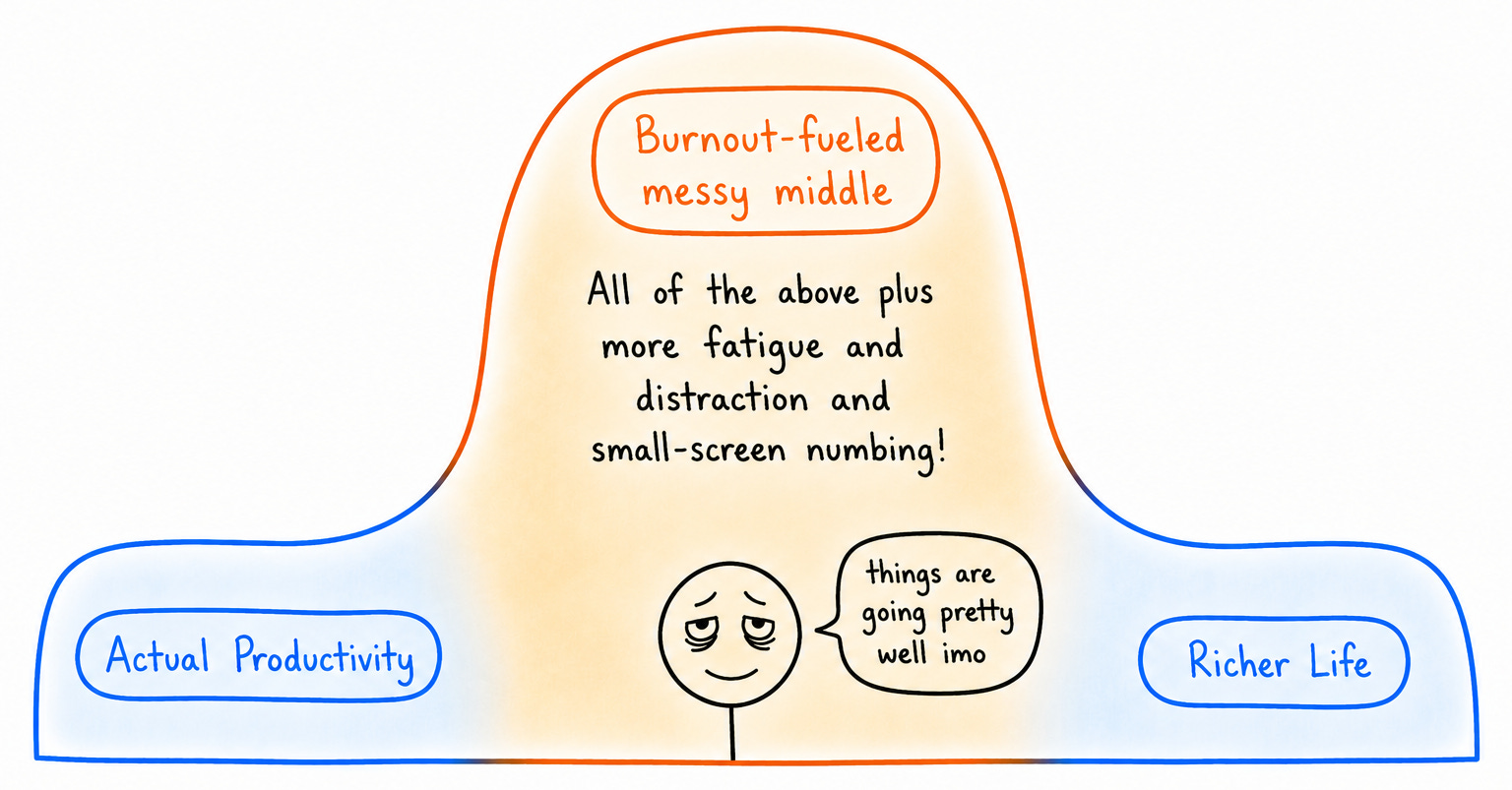
Needless to say, this state is not great for someone’s wellbeing.3
III. A Better Future
"Human beings were not meant to sit in little cubicles staring at computer screens all day." – Peter Gibbons
I don’t consider myself a techno-salvationist. I’ve written recently that AI is not the bottleneck keeping us from solving most problems, and that the American economy’s post-recession growth has largely been a byproduct of capturing and selling human attention.
That said, as AI models improve, the following Good Barbell can increasingly replace the Unpleasant Bell Curve.
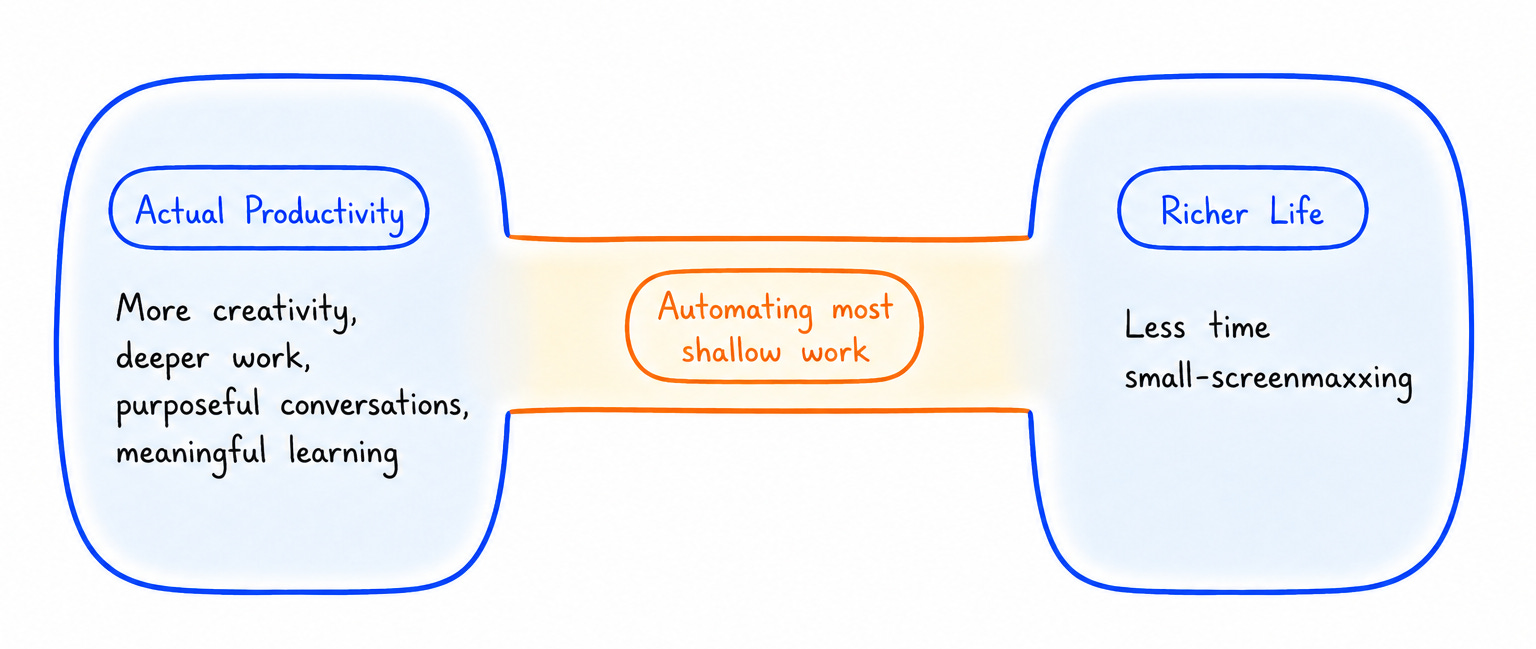
We can achieve the Good Barbell through a combination of tech improvements and shifting cultural norms.
Some AI tools already reduce time in the messy middle.
I’m not affiliated with or paid by either of these companies, but I use Granola as an intelligent meeting recorder to reduce note-taking burden, and, separately, Whispr Flow to dictate text, like a writing outline, with high fidelity.
Tools like Granola can reduce laborious meeting follow ups, and they make it harder to justify the “sorry-I’m-sending-Slacks-while-I’m-pretending-to-listen-to-you” 1:1 meetings.4
Group meetings and 1:1 meetings should either be on the left side of the barbell or not exist at all; most corporate meetings are performative, in my opinion. If you can justify being routinely distracted in a meeting, it’s not an important meeting.
Some bigger tech leaps are foreseeable.
Agents will soon handle almost all purely-admin tasks: purchases, updating databases, building spreadsheets, etc. Error rates will improve over time until we humans are only in the loop only to verify the final output.
Agents will help reduce the time we spend on the ultimate attention killer, the hive-mind world of email and Slack/DMs. They’ll be our copilots (except more useful than the first wave of copilot hype) that observe and synthesize our deeper work and meetings, and then share accurate updates on our behalf.5
There will be custom, “vibe-coded” apps for individuals and teams (especially for less vulnerable applications) instead of using expensive third-party apps that have superfluous features. Software will be increasingly democratized.
Some even bigger leaps are not obvious, or at least easily forecastable, today:
What if phones and laptops aren’t the primary interfaces come 2036? It’s at least possible.
What if emails and DMs were replaced by something else entirely?
If these tech leaps seems far-fetched, consider these two common blind spots:
We overrate how much things will change in one year, but underrate how much they’ll change in 10 years (e.g., a college campus in 2016 would be unrecognizable to a pre-iPhone campus of 2006).
We forget that 2026 → 2036 will involve just as much change, if not more (the “end-of-history” illusion).
IV. Conclusion: Changing the Norms
“The thing is, Bob, it’s not that I’m lazy, it’s that I just don’t care.” – Peter Gibbons
Focused people have an advantage over multitaskers, which means the current system’s default sets us up for failure.
Organizations that more quickly shift to the Good Barbell will have more successes. As AI agents improve, forward-thinking teams will spend less time in a state of hive-mind distraction and more time:
Doing actual productive work and having purposeful meetings.
Intensely planning and frequently refining the systems that automate the messy middle, since offloading shallow tasks without accuracy just means you’re running in circles.
As Cal Newport argues in books like Slow Productivity and Deep Work, there’s nothing stopping us from implementing more focused work cultures today (i.e. before agents get better). Yet, tech evolves faster than corporate norms, so most orgs will only change once there is no longer an excuse to continue working in the shallows.
Beyond the strategic edge for businesses, it’s better for everyone if there is less burnout, happier people, and more attention directed to the things and relationships that matter.
Some of these professionals, e.g. teachers, were forced to work remotely during COVID, and it quickly became clear that remote schooling was suboptimal for everyone. Teachers are therefore excluded from the definition.
From Dickens’ A Christmas Carol (1843).
For what it’s worth, it’s bad for well-meaning employers too. Consider the rise of “quiet quitting.”
The two best sales leaders I’ve worked with were 10x more present in our 1:1 meetings than the norm. Employees not only notice, but palpably feel, when a manager is present. Both of those leaders are extremely successful, which I don’t think is a coincidence. Presence is a strength and it’s sadly uncommon.
You’d want to keep much of this out of the Cloud (read: a bigger company’s servers that you connect to over the Internet). But as open-source AI models continue improving, more of these AI assistants will be run locally or on private networks.