

Energy Abundance, Golems, and Athleisure Ape Blind Spots
Featuring Oklahoma public radio

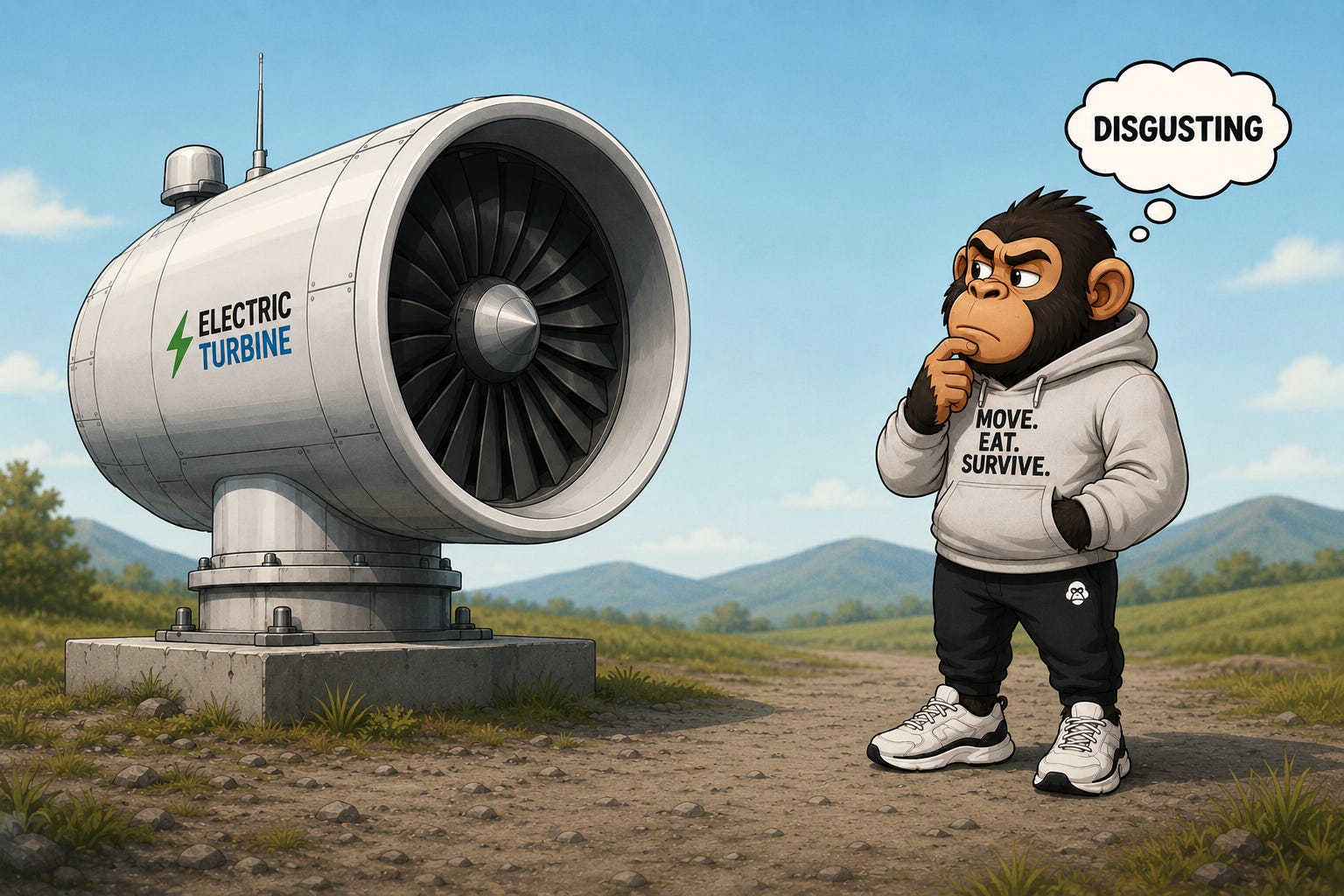
I. The uncanniness of another man’s echo chamber
In 2019, I took a road trip from Kentucky to Big Bend National Park in far west Texas with two of my friends / college roomies. On our return trip through Oklahoma City, we caught a AAA baseball game that was lightninged-out. ‘Twas electric.
At some point on a remote stretch of highway in the middle of Oklahoma, beset by monotony, we put on local talk radio. The talker’s voice sounded much like Boomer-financial-hero Dave Ramsey, and we had many good laughs from the Ivory Tower of my 2013 Hyundai Sonata as Faux Dave Ramsey pontificated for an hour about the threat of a “Red-Green Alliance” in America.
For context, after the 2018 elections, young progressives like AOC created a “Green New Deal” wing of the Democratic Party. Their stated intention was to pair urgent climate action with a revamped welfare state that resembled the original New Deal.
Per the Oklahoma radio host, this Green New Deal was actually a Communist Trojan Horse, hence the “red” part of the alliance. Per the radio man, the goal of this progressive wing was to teach the children of Oklahoma—at communist elementary schools powered by Liberal solar panels—about the myriad sins of their cisgender parents.1
As bizarre as it was to drop in on someone else’s reality in the age of personally curated, belief-reinforcing echo chambers, I largely forgot about that anecdote given the U.S. has not yet become a biomass-powered People’s Republic. However, the “Red-Green Alliance” diatribe resurfaced in my mind after reading two authors during my medical recuperation this year.
The first is Tim Urban (creator of Wait But Why?, my favorite blog that I frequently mention on FoT) and his 2023 debut book, What’s Our Problem?
The other is Václav Smil, a Czech polymath who’s written 40+ books about energy, globalization, etc. Notably, he’s also the favorite author of the extremely well-read and newly-problematic Bill Gates.2
II. The problem is vertical, not Left or Right
Tim Urban’s book was excellent, involving everything from hundreds of stick-figure drawings to a “Tim’s-career-tanking deep dive into America’s social justice movement.”
My three-bullet summary of What’s Our Problem?:
Bad times, like WWII or the weeks following 9/11, bring out Americans’ “higher minds,” shared humanity, and our wisest selves.3
After many decades as the de facto global leader, the good times dragged America’s higher minds down to the lower rungs of distrust, tribalism, and primitive reactive thinking.
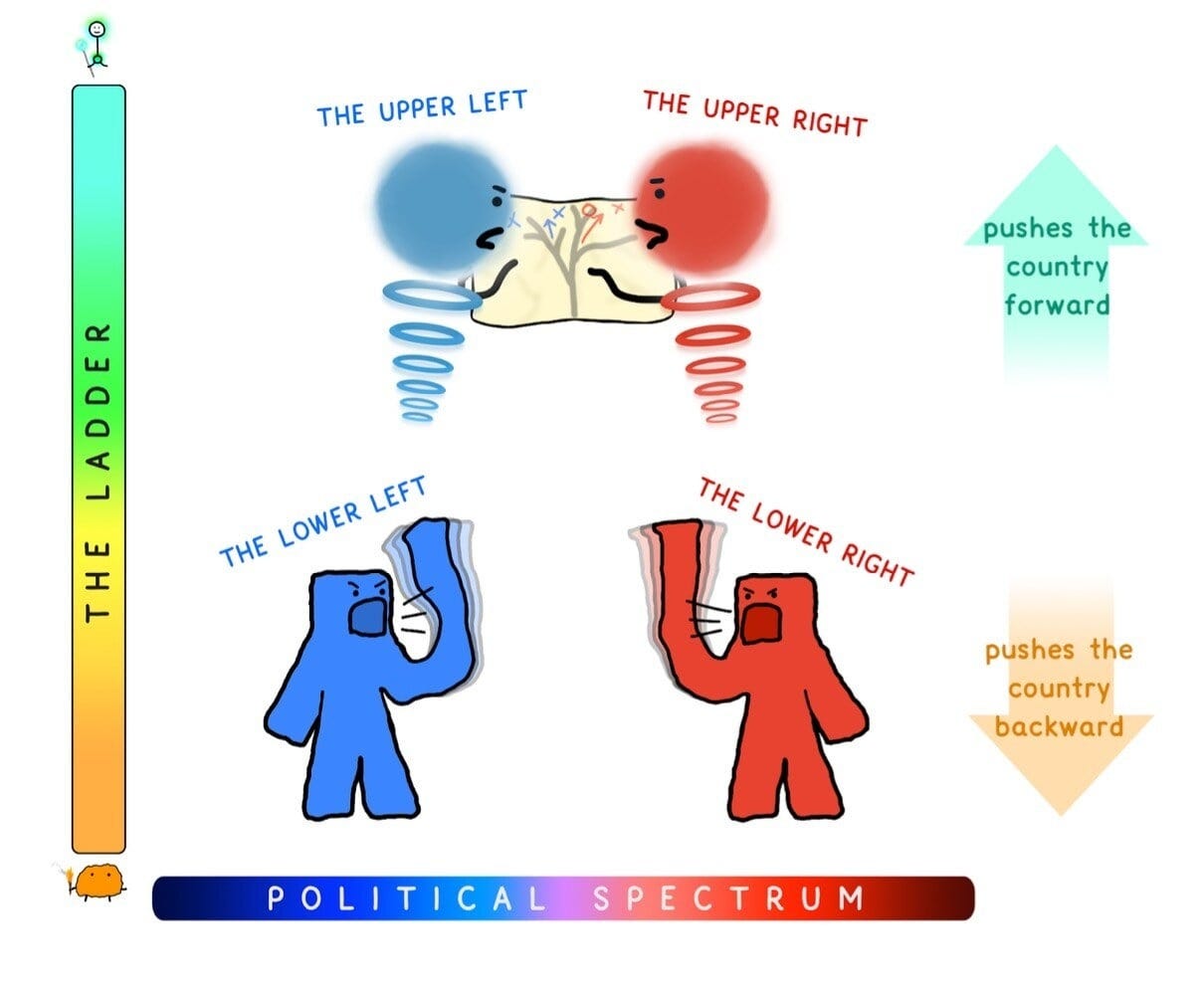
Our problem is not Left vs. Right, per se, but the intolerant, bad-faith-arguing, illogical rock fights of the Lower Right and Lower Left: the “Golems” (see image) that run on our primitive mental software. The ape part of the Athleisure Ape that we’ve previously discussed.4
A paradox of life is that it’s a miracle to be born a human and tragic to live so briefly (relative to the age of rocks and such).
Since we’re born as mere big-brained apes, we would be completely feral without socialization. Our wisdom comes from nurture, not nature. We spend a lifetime becoming wise, yet we can’t share that wisdom through our genes. The only way to share our knowledge and wisdom is through parenting and documenting what we know (e.g. writing).
In theory, new morsels of wisdom (e.g. gay marriage should be allowed) would add to the huge pile of existing wisdom, and every successive generation would be unprecedented in their wisdom.
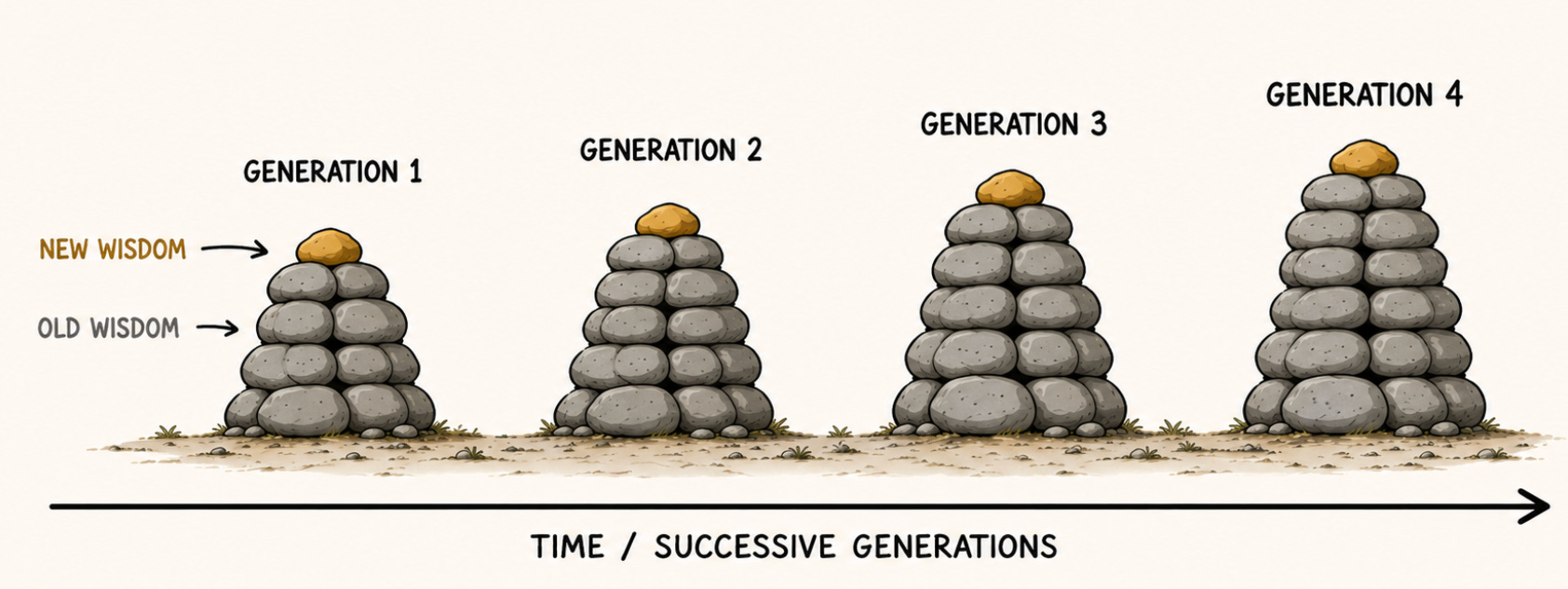
Obviously that’s not how things go.
Instead of accelerating wisdom, after a couple decades of relative prosperity and peace, almost nobody alive remembers WWII or the Great Depression, so we become entitled and lose perspective and slip down to the unreasonable lower rungs rife with tribal, reactive fighting.
III. The ape’s blind spot
In How the World Really Works, Václav Smil spends the first chapter putting energy transitions into perspective. Based on Smil’s numbers, we can state the following5:
The fossil-fuel era represents 0.000006% of the time since life first appeared on Earth ~4 billion years ago.
It represents 0.006% of the time since early humans left the trees ~4 million years ago.
And 0.08% of the time since modern sapiens emerged ~300,000 years ago.
And 2.5% of the time since agriculture began ~10,000 years ago.
The fossil-fuel era is an infinitesimal blip of time. Yet, because every living person was born inside this blip, it feels like an inevitable endowment of civilization. This system still powers our transportation, electricity, road pavement, and countless daily synthetic materials.
The mistake was not the miraculous discovery and refinement of fossil fuels as a source of energy, but our reluctance and tardiness to switch to more sustainable energy forms in the past 50 years. It will be very difficult to quickly and widely reduce our dependence on these finite, climate-altering sources of energy.
Somehow, during the past few decades, the terms “energy” and “climate” and “fossil fuels” started to send the athleisure ape into a frenzy. Today, any discussion around energy—the most important economic topic—plunges most politically active people straight into the lowest rungs on the ladder.
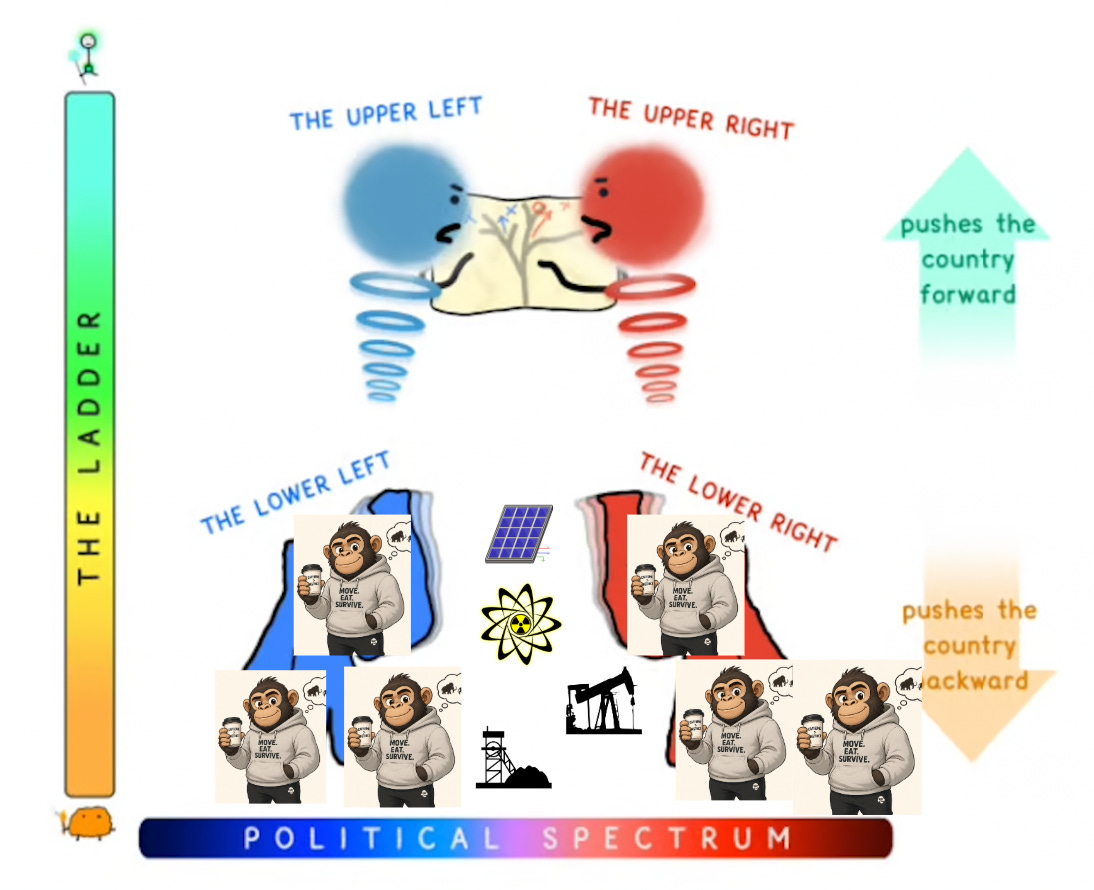
It’s devastating for our country and the world (by virtue of America’s spot in the global arena) that so many people’s IQ drops by ~85 points when this subject arises.
And it’s bizarre that modern Conservatism self-identifies with “conserving” a mere centuries-old practice of burning fossil fuels, when the sun is arguably much older. Also, the consensus Right is somehow pro-business but against rapidly pursuing energy abundance, a breakthrough that would have the literal biggest impact on business and wealth. Look no further than the Oklahoman purported “Red-Green alliance” to see that, when it comes to hope for an energy-abundant future, the use of our brains is sparse.
To be clear, the Left is culpable on this issue too. Beyond name-calling the Right and stoking the flames of distrust, there is often more talk than action: Texas—a known red state—is dramatically outpacing California in the pace of its solar buildout.
IV. The case for optimism
To be very clear, my goal is not to join the low-rung partisan games by casting Left-Right blame. Instead, I aim to highlight the unprecedented economic opportunity of a public- and private-sector megabet on energy abundance.
Energy production, and its availability for industry and consumers, doesn’t happen magically, yet economic discussions “not only lack any systematic awareness of energy’s importance for the physical process of production… [they also act] as if output could be produced by labor and capital alone—or as if energy is merely a form of man-made capital that can be produced (as opposed to extracted) by labor and capital” (Smil).
The post-WWII economic boom relied on a huge increase in petroleum at the same time that prices fell. People took that trend for granted until the shocks of the mid-1970s hijacked global growth rates for a decade.
That pattern repeats. Energy was definitely not the most visible issue in American politics in recent years, but it’s back near the forefront thanks to data center animosity that’s only going to worsen.
The pursuit of energy abundance can keep us out of unnecessary wars in the Middle East, and it can create truly unprecedented societal wealth, yet we treat energy as an invisible input and let China dunk on us as they build out increasingly cheap solar (see also: “China Installed More Solar Panels Last Year Than the U.S. Has in Total”).
When the topic of energy descends into Tim Urban’s low-rung Golem land—whether it’s Conservatives equating fossil fuels with freedom or progressives naïvely believing that a new New Deal could magically eliminate them within a few years—we compromise the future for everyone.
Energy abundance requires both groundbreaking new technology and political will. It will also enable a new American social contract.6
If we can ascend from Golem Land, the future of energy and electricity will indeed be lit.
My quote is subject to inaccuracies after seven years. Do not sue me for libel, Oklahoma public radio.
Smil is interviewed in the 2019 Bill Gates Netflix docuseries and says that Gates is likely the only person who’s read all of his books.
In Lincoln’s first inaugural address—at one of the few American points more polarized than today—Lincoln similarly appealed to the “better angels of our nature,” i.e. the more vertical rungs in that graphic above.
It may seem arrogant to deem one’s political opinions independently “above” the culture wars of Fox News and MSNBC, but know that if I’m arrogant, so too is America’s most polarizing alleged-murderer sex symbol, Luigi.
We’re using 1776 as the year that the age of fossil fuels began for the sake of 250 years being a round number around the start of the Industrial Revolution.
Groundbreaking tech and a new social contract are two of the three main pillars of FoT. The third is regaining attention freedom from big tech.